

What Is the Penalty for Assault in Canada? Understanding Section 266 of the Criminal Code
Assault in Canada means intentionally applying force to someone without consent under Section 265. Toronto lawyers explain your charges and legal options.
Summarize this article with AI


Reviewed by Jonathan Pyzer, a criminal defence lawyer with over 23 years of experience and lead counsel at Pyzer Criminal Lawyers - Criminal Lawyers Toronto.
Assault charges are common in Canadian courts, and the consequences can be severe. The offence of assault includes anything from threatening acts or gestures to physical contact with another person, and the penalties range from discharge options in some cases to up to 14 years’ imprisonment for aggravated assault.
A conviction can remain on a person’s criminal record unless it is addressed through the record suspension process. This can affect their ability to travel to the U.S., rent a home, volunteer, or pursue careers in teaching, childcare, or medicine.
If you have been charged with assault, speak to an experienced assault lawyer at Pyzer Criminal Lawyers and request a free case consultation. We will help explain your charges and the likelihood of success.
Key Takeaways
● Assault is defined in Section 265(1) of the Criminal Code and includes force, threats made through an act or gesture, and certain weapon-related conduct.
● Common assault is prosecuted under Section 266.
● Assault with a weapon or causing bodily harm is prosecuted under Section 267.
● Aggravated assault is prosecuted under Section 268 and carries a maximum penalty of 14 years.
● Most assault offences are hybrid, so the Crown may proceed by summary conviction or indictment. The election affects the procedure and maximum penalties.
What is Assault?
According to Section 265(1) of the Criminal Code, a person commits an assault when:
- without the consent of another person, they apply force intentionally to that other person directly or indirectly;
- they attempt or threaten, by an act or a gesture, to apply force to another person, if they have, or cause the other person to believe on reasonable grounds that they have, present ability to carry it out; or
- while openly wearing or carrying a weapon or an imitation thereof, they accost or impede another person or beg.
The offence of assault applies to all forms of assault, including sexual assault, sexual assault with a weapon, threats to a third party, or causing bodily harm, and aggravated sexual assault.
Common assault is prosecuted under Section 266 of the Criminal Code. The Section 265 definition applies to common assault and to other assault offences. Threat-based assault requires an act or gesture, not words alone.
In Canada, there are three main levels of assault in the Criminal Code:
● Level 1: Common Assault (s. 266)
● Level 2: Assault causing bodily harm or assault with a weapon (s. 267)● Level 3: Aggravated assault (s. 268) (wounding, scarring, maiming, disfiguring, or endangering the life of the victim)
What the Crown Must Prove for an Assault Conviction
The Crown prosecution has to prove the following three elements beyond a reasonable doubt:
● That the accused applied force to another person;
● That the other person did not consent to having the force applied to them; and
● That the accused applied force to another person intentionally.
If the Crown does not meet that burden, the accused must be acquitted.
For assault by force (s. 265 (1) (a)), the Crown must prove the following:
● Identity: Must prove that the accused is the person who committed the offence.
● Date, time, and jurisdiction: Must prove when and where the offence occurred.
● Force: Must prove that force was applied to the complainant, whether it was direct or indirect.
● Intentional: Must prove that the accused intended to assault the victim (it didn’t happen accidentally).
● Consent: Must prove that the complainant did not consent to the force applied to them.
For assault by threat (s. 265 (1) (b)), the Crown must prove the following:
● Attempt or threat: The Crown must prove that the accused attempted to or threatened the complainant by an act or gesture.
● Present Ability or Reasonable Belief: The Crown must prove that the accused had the present ability to carry out the assault or that the complainant had a reasonable belief that the accused had the ability to do so.
● Physical Contact: No physical contact is required for the offence; only a threat is required.
For assault while carrying a weapon (s. 265 (1) (c)), the Crown must prove the following:
● Weapon or Imitation: The Crown must prove that the accused was openly wearing or carrying a weapon or an imitation weapon.
● Prohibited Conduct: While carrying the weapon, the accused accosted (approached), impeded (interfered with or blocked), or begged another person.
Types of Assault Charges in Canada
Assault charges in Canada range from common assault (s. 266) to aggravated assault (s. 268). In the Criminal Code, the different levels of assault are determined by the degree of force used, the extent of, or if any, harm caused, and other circumstances.
Most assault offences are hybrid offences, which allow the Crown to choose whether to proceed summarily or by indictment. If the Crown chooses to proceed summarily, the maximum penalty would be two years less a day imprisonment and/or a $5,000 fine.
If the Crown proceeds by way of indictment, it means the Crown is treating the case as more serious and may seek a custodial sentence, and the maximum penalty can range from 5 years to 14 years, depending on the offence. Aggravated assault is strictly indictable, and no summary conviction is available.
What is Assault Causing Bodily Harm or Assault with a Weapon?
Assault with a weapon or causing bodily harm is a more severe assault than common assault, and it carries a higher penalty. Waving a knife or a firearm, or using an object to strike someone, can constitute assault with a weapon. Carrying a weapon can also affect how the Crown assesses the case and what charge is laid.
The Code defines bodily harm as “any hurt or injury to a person that interferes with the health or comfort of the person, and that is more than merely transient or trifling in nature.” Essentially, it is any injury that is more than a temporary or brief discomfort.
Under Section 267 of the Criminal Code, an individual commits assault with a weapon or bodily harm when they commit an assault and:
- carries, uses, or threatens to use a weapon or an imitation thereof,
- causes bodily harm to the complainant, or
- chokes, suffocates, or strangles the complainant.
If convicted, one could face up to 10 years if the Crown proceeds by indictment. Whether a conditional sentence order is legally available depends on the current conditional sentence rules and the sentence imposed. If the Crown proceeds summarily, upon conviction, one may face up to 2 years less a day.
What is Considered a Weapon?
Under the Criminal Code, “weapon” includes any thing used, designed to be used, or intended for use in causing death or injury, or for threatening or intimidating a person. That means the most unsuspecting objects, for instance, a coffee cup or cell phone, can be considered a weapon for the purposes of assault under the Criminal Code.
What is Aggravated Assault?
Aggravated assault is found in Section 268(1) of the Criminal Code, which defines it as wounding, maiming, disfiguring, or endangering the life of a person during an assault.
Aggravated assault is always an indictable offence, as there is no summary option available, and if convicted, one can face the maximum penalty of 14 years’ imprisonment. When sentencing, the judge will consider the level of injury caused and the circumstances surrounding the assault.
A conditional sentence order is only available if the court imposes a sentence of less than two years and the statutory conditions are met. In practice, aggravated assault convictions often result in penitentiary time.
Sexual Assault
Sexual assault is a serious crime in Canada, and if convicted, the accused faces a prison sentence of up to 14 years. An assault committed in a sexual context will lead to a sexual assault charge. Sexual assault, specifically, is found under Section 271 of the Criminal Code.
Sexual assault uses the Criminal Code assault definition, with the added sexual nature of the contact. Any form of nonconsensual contact is considered sexual assault.
The type of sexual assault charge will be decided by any aggravating factors, such as the use of a weapon. Learn more about these charges in our recent article explaining the different types of sexual assault charges in Canada.
Domestic Assault
Domestic assault is not specifically listed in the Criminal Code. Assault is considered domestic assault when the assault occurs within the context of a domestic or intimate relationship. Any form of nonconsensual force from one party onto another in a domestic setting, such as between family members or spouses, would be considered domestic assault. Domestic assault allegations are often treated as higher-risk in bail and sentencing decisions, depending on the facts.
To learn more about what domestic assault is, read our recentarticle on domestic assault.
Penalties and Sentencing for Assault in Canada
When sentencing someone found guilty of a criminal offence, the judge considers many factors to determine a fair sentence, many of which are set out in the Criminal Code. These include the level of force or injury, the circumstances of the offence, any prior criminal record, aggravating and mitigating factors, and whether the conviction was indictable or summary.
For every assault that occurs, there are different levels of injury. When there is minimal injury, judges may take it less seriously than when there is serious or long-term harm. The less harm done, the lower the sentence is likely to be.
In addition to the level of harm, the circumstances surrounding the offence are always important factors to consider. In the context of assault, a judge will look at whether or not the assault was planned, if there were weapons involved, if drugs or alcohol were involved, where it occurred (workplace, domestic setting, etc.), and if the victim was someone who could be considered vulnerable, such as an elderly, underage, or disabled person.
After reviewing these, a judge will also consider the person’s past criminal record. If the person has been convicted of crimes before, they will look at the crime, the relevant circumstances, and the sentencing. If there are any crimes remotely similar to the current assault conviction, the judge will likely take this into account and may view it as a repeat offence.
In every offence, there are always aggravating and mitigating factors that can both help or hurt your case. Aggravating factors are likely to increase your sentence. While specific to each individual crime, these typically include:
● the use of a weapon;
● targeting a vulnerable person;
● hate-motivated crimes, etc.
The fewer aggravating factors your case has, the lower your sentence will likely be.
Mitigating factors are likely to decrease your sentence. These may include:
● there being no or minimal injuries;
● significant remorse and accountability;
● provocation (to an extent);
● mental health conditions, etc.
Finally, the judge must look at whether the conviction was indictable or summary. For summary conviction offences, the default maximum is two years less a day and/or a $5,000 fine, unless a different maximum is set by law. For any indictable conviction, the imprisonment is typically much higher. For all assault charges, with the exception of aggravated assault (regular or a peace officer), summary convictions are available.
The Crown has the decision to prosecute summarily or indictably. If the Crown chooses to go by way of indictment, then it is at the judge’s discretion to impose up to the maximum penalty for the offence.
See the chart below for the maximum penalties by offence.
| Assault Charge | Indictable Conviction | Summary Conviction |
| Assault s. 266 | Maximum 5 years | Available |
| Assaulting a peace officer with a weapon or causing bodily harm s. 270.01(1) | Maximum 10 years | Available |
| Aggravated assault s.268 | Maximum 14 years | Not available |
| Assaulting a peace officer s. 270 | Maximum 5 years | Available |
| Assaulting a peace officer with a weapon or causing bodily harm s. 270.01(1) | Maximum 10 years | Available |
| Aggravated assault of a peace officer s. 270.02 | Maximum 14 years | Not available |
| Maximum 18 months if the complainant is over 16 years old. Maximum two years less a day if the complainant is under 16 years old | Maximum 18 months if the complainant is over 16 years old. Maximum two years less a day if the complainant is under 16 years old | Maximum 18 months if the complainant is over 16 years old. Maximum two years less a day ifthe complainant is under 16 years old |
Penalties for Assault Charges in Canada
Simple Assault
The sentencing time for assault will vary depending on the amount of force used in the assault and other factors surrounding the offence. Read our article on what is the sentencing time for assault to learn more about potential sentences.
Section 266 of the Criminal Code sets out the penalties for common or simple assault. It states:
Everyone who commits an assault is guilty of:
- an indictable offence and is liable to imprisonment for a term not exceeding five years; or
- an offence punishable by summary conviction.
If the Crown proceeds by way of an indictable offence, the accused is liable to a prison term not exceeding five years. That means a court has the discretion to sentence the accused to no jail time or to a maximum of five years in jail. Typically, if the Crown proceeds by indictment, they are seeking a prison sentence. If the Crown proceeds by way of summary conviction for common assault, the accused is liable to a fine not exceeding $5,000 and/or a maximum prison term of two years less a day..
While there is no mandatory minimum sentence for this conviction, the judge has discretion to impose a sentence that fits the circumstances. The options available to the judge include a discharge, either absolute or conditional; a suspended sentence; a standalone fine; custody; or a conditional sentence.
An absolute discharge is available under Section 730, allowing the accused to be released without conditions and with no criminal record after one year. A conditional discharge will avoid a criminal record but will require the offender to follow probation conditions for up to three years.
A suspended sentence is available under Section 731(1)(a), where the offender is placed on probation with conditions, and no immediate punishment, such as custody, is imposed.
A standalone fine, available under Section 731(1)(b), is a monetary amount set to be paid by the offender after a conviction has been made.
Custody, under Section 718.3, may be imposed if the offence is serious, up to the maximum time allowed under the conviction.
A conditional sentence, available under Section 742.1 when the sentence would be less than two years, is given when the offender can serve their sentence in the community under supervision and/or house arrest.
Aggravated Assault
Aggravated assault is strictly an indictable offence. If convicted, the court may impose a penitentiary sentence, depending on the facts. A conditional sentence order depends on the current statutory test and the sentence imposed.
Aggravated assault is always an indictable offence, and the maximum penalty is 14 years in jail. To determine the length of imprisonment, the judge will consider the level of injury the accused inflicted, as well as the circumstances surrounding the offence.
Assault Causing Bodily Harm or Assault with a Weapon
Assault causing bodily harm or assault with a weapon are hybrid offences. If the Crown proceeds by way of an indictable offence for assault with a weapon or causing bodily harm, the maximum penalty is 10 years in jail. If the Crown elects to proceed by way of summary conviction, the general penalty is a maximum of two years less a day in jail, and/or a fine of not more than $5,000.
A conditional sentence order depends on the sentence imposed and the current statutory test. For example, if an individual is found guilty by way of indictment for the offence of assault causing bodily harm and/or assault with a weapon, a conditional sentence is not available.
Assault Sentencing Ranges in Ontario
In Ontario, the sentencing ranges for assault offences are guided by the Criminal Code and provincial sentencing patterns.
For first-time offenders, the courts generally have very similar ranges, unless the assault’s circumstances justify a reason to stray. Judges typically use the following ranges as guidelines:
● Common assault charge: Discharge (absolute or conditional) to up to 30 days in jail.
● Assault Causing Bodily Harm: 30 days to 18 months imprisonment.
● Aggravated Assault: 2 to 6 years imprisonment.
Any cases involving domestic assault typically receive enhanced scrutiny and mandatory conditions such as strict no-contact orders, strict probation supervision, and/or counselling programs.
In any case involving peace officers convicted of assault, a lenient range of 30 to 60 days is recommended, taking into account aggravating and mitigating factors.
Sentencing for assaults on children considers three categories of culpability: low, moderate, and high. Typically, low is a minimal offence with minimal injuries, moderate consists of repeated incidents and some injuries, and high consists of severe incidents with serious bodily harm. The higher the culpability, the higher the sentence.
What Happens if You’re Charged With Assault for the First Time in Canada?
When you are charged with assault for the first time in Canada, you are typically treated more leniently than repeat offenders, especially if the offence was minor and there were no serious injuries. Typically, the Crown and judge will consider the following options:
- Discharge: Under Section 730 of the Criminal Code, the court has the discretion to grant either an absolute discharge or a conditional discharge. When an absolute discharge is given, there are no conditions or a conviction, and the criminal record is removed after one year. When a conditional discharge is given, there are still no convictions; however, the offender must comply with probation conditions.
- Peace Bond: When seeking to avoid a criminal record entirely, a peace bond may be offered as an alternative. In a peace bond, the accused agrees to “keep the peace” and follow specific conditions set by the judge, such as staying away from the complainant.
- Diversion: Another option is a diversion program. In Ontario, eligible first-time offenders can participate in a diversion program that often includes rehabilitation, counselling, community service, and other measures. If successfully completed, the charges will be withdrawn, and the accused will have no criminal record.
Typically, a first-time offender’s outcome for a common assault charge, which consists of minimal contact or threats without a weapon, is either an absolute or conditional discharge or a suspended sentence with probation.
However, depending on the circumstances, imprisonment is still an option for first-time offenders, especially for serious crimes. Early legal advice can help the accused understand options, conditions, and risk. Every case is different, and a lawyer knows how to properly protect your rights and advocate for reduced charges where possible.
Possible Defences for Assault Charges
A defence is determined by the legal team by first analyzing the facts of the case, the evidence, and the laws that may apply. After reviewing everything, the legal team assesses the strengths and weaknesses of the Crown’s case against the accused and the best way to proceed. The legal team will present the defences to the defendant and explain the best course of action. The following are some of the defences typically used:
Self-Defence
Self-defence must have an “air of reality” based on the evidence. If that threshold is met, the Crown must disprove self-defence beyond a reasonable doubt.
Section 34 of the Criminal Code states that a person is not guilty of an offence if:
- they believe on reasonable grounds that force is being used against them or another person or that a threat of force is being made against them or another person;
- the act that constitutes the offence is committed for the purpose of defending or protecting themselves or the other person from that use or threat of force; and
- the act committed is reasonable in the circumstances.
Defence of Consent
If consent is given by the other party, assault is not considered criminal. For example, a consensual fistfight is not necessarily an assault because the parties are consenting to physical contact with one another. However, if consent was given by way of force, threats, fraud, or authority, it is not considered legal consent.
Section 265(3) of the Code states that for the purposes of assault under Section 265, no consent is obtained where the alleged victim submits or does not resist by reason of:
(a) the application of force to the victim or to a person other than the victim;
(b) threats or fear of the application of force to the complainant or to a person
other than the complainant;
(c) fraud; or
(d) the exercise of authority.
Honest but Mistaken Belief in Consent
The Criminal Code under Section 265(4) states the following regarding an accused’s mistaken belief in consent:
Where an accused alleges that he believed that the complainant consented to the conduct that is the subject matter of the charge, a judge, if satisfied that there is sufficient evidence and that, if believed by the jury, the evidence would constitute a defence, shall instruct the jury, when reviewing all the evidence relating to the determination of the honesty of the accused’s belief, to consider the presence or absence of reasonable grounds for that belief.
That means that if the accused honestly but mistakenly believed the other party had given consent, the accused may use that belief as a defence. If you are making this defence, you are confessing to committing an assault. The criminal law is complex and perplexing. Do not try to deal with it by yourself. If you are charged with any form of assault, contact us at Pyzer Criminal Lawyers to get the best outcome.
Trivial Touching
Another defence option may be de minimis, also known as trivial touching. The defence can be used when the physical contact was insignificant or harmless. The focus is that the contact is minimal enough not to interfere with the complainant’s comfort or security.
How Common is Assault?
The following table from Statistics Canada shows incidents of simple assault in Canada from 2022 to 2024:
| 2022 | 2023 | 2024 | |
| Actual incidents | 196,990 | 209,899 | 215,460 |
| Rate per 100,000 population | 505.93 | 523.65 | 521.84 |
| Total persons charged | 75,306 | 77,815 | 79,629 |
| Total adult charged | 70,784 | 72,483 | 73,913 |
Simple Assault Incidents in Canada from 2022 to 2024, according to Stats Canada
Stats for Assault Level 2, Weapon or Bodily Harm
| Statistics | 2022 | 2023 | 2024 |
| Actual incidents | 77,187 | 85,497 | 87,500 |
| Rate per 100,000 population | 198.24 | 213.30 | 211.92 |
| Total persons charged | 41,414 | 45,328 | 47,422 |
| Total adult charged | 37,978 | 41,097 | 43,058 |
Assault Level 2 Incidents in Canada from 2022 to 2024, according to Stats Canada
Stats for Assault Level 3, Aggravated Assault
| 2022 | 2023 | 2024 | |
| Actual incidents | 4,218 | 4,476 | 4,254 |
| Rate per 100,000 population | 10.83 | 11.17 | 10.30 |
| Total persons charged | 3,428 | 3,738 | 3,540 |
| Total adult charged | 3,046 | 3,286 | 3,129 |
Assault Level 3 Incidents in Canada from 2022 to 2024, according to Stats Canada
Assault Rates in Canada
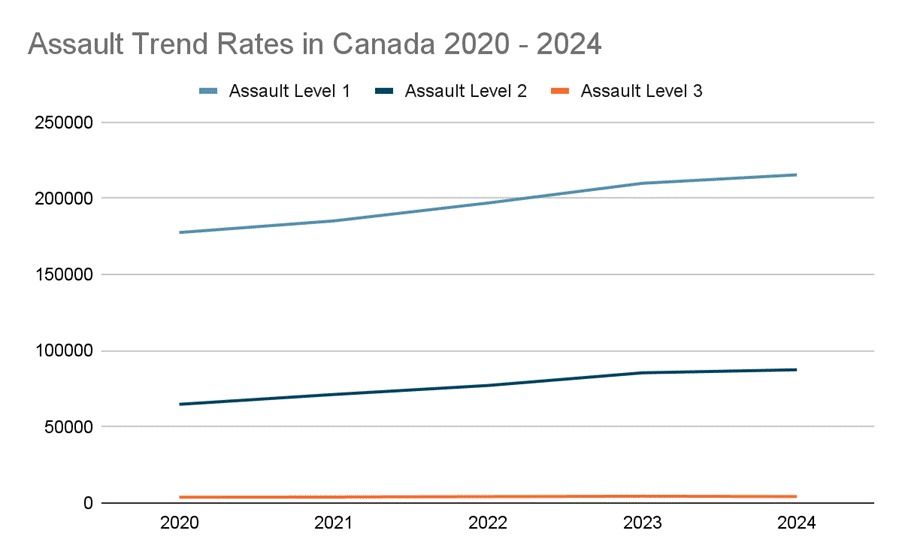
Assault Trends from 2020 – 2024 for Assault Level 1, 2 and 3
Assault Rates for Major Canadian Cities
Trending Rates of Incidents Occurred in 2020 vs 2024 in Major Canadian Cities
| City | Level 1 Incidents Occurred | Level 2 Incidents Occurred | Level 3 Incidents Occurred |
| Toronto | 2020: 17,7562024: 26,821 Trend: 51% increase | 2020: 6,6692024: 10,210 Trend: 53% increase | 2020: 3172024: 290 Trend: 9% decrease |
| Vancouver | 2020: 10,8052024: 10,421 Trend: 4% decrease | 2020: 5,1162024: 4,809 Trend: 6% decrease | 2020: 1252024: 138 Trend: 10% increase |
| Montreal | 2020: 16,2302024: 20,890 Trend: 29% increase | 2020: 6,0942024: 9,139 Trend: 50% increase | 2020: 852024: 178 Trend: 109% increase |
| Calgary | 2020: 5,9012024: 7,673 Trend: 77% increase | 2020: 2,8122024: 3,756 Trend: 34% increase | 2020: 1262024: 132 Trend: 5% increase |
| Ottawa | 2020: 2,7112024: 3,638 Trend: 34% increase | 2020: 9582024: 1,419 Trend: 48% increase | 2020: 732024: 84 Trend: 15% increase |
| Edmonton | 2020: 5,2432024: 7,716 Trend: 47% increase | 2020: 3,5762024: 4,319 Trend: 21% increase | 2020: 4672024: 419 Trend: 11% decrease |
If you or someone you know is facing assault charges in Toronto, our experienced assault defence lawyers are here to help. We offer a free consultation to discuss your case and provide the best possible defence strategy. Don’t hesitate to reach out to us for more information. Your future is important to us, and we are committed to protecting your rights.
This article provides general legal information only and should not be construed as legal advice. Laws and their interpretation may change, and the application of law to specific circumstances requires professional legal assessment. If you have questions about a legal matter, please contact us for a free consultation.

Jonathan Pyzer
Jonathan Pyzer, B.A., L.L.B., is an experienced criminal defence lawyer and distinguished alumnus of McGill University and the University of Western Ontario. As the founder of Pyzer Criminal Lawyers, he brings over two decades of experience to his practice, having successfully represented hundreds of clients facing criminal charges throughout Toronto.
Request a Free
Case Evaluation





5.0

