

Understanding Bear Spray Laws in Canada
Bear spray is legal in Canada for wildlife use only and using it on humans is a Criminal Code offence. Charged? Toronto lawyers explain the law & defences.
Summarize this article with AI


Reviewed by Jonathan Pyzer, a criminal defence lawyer with over 23 years of experience and lead counsel at Pyzer Criminal Lawyers - Criminal Lawyers Toronto.
When you are out exploring the Canadian wilderness, it is important to carry the tools necessary to protect yourself from dangerous wildlife encounters. While hiking and camping in certain regions, carrying bear spray can be a critical tool to carry for your personal protection to avoid a bear attack.
Carrying bear spray is legal and provides you with an important line of defence in the event that you encounter a bear by deploying a burst of pepper spray, which irritates a bear’s eyes and causes them to retreat.
Bear spray should only be used as a last resort, and attempts should be made to get out of the bear’s way first. You should yell “Hey Bear” if the bear is coming towards you, and only use the bear spray if the bear is sufficiently close to you.

Is your Bear Spray possession legal?
Avoid Prohibited Weapon charges. Get urgent advice now.
Key Legal Points: Bear Spray in Canada at a Glance
Key facts regarding bear spray laws in Canada:
Legal Consequences: Potential assault charges and weapons offences.
For Animals Only: Bear spray is legal for deterring bears and other wildlife in Canada.
Illegal for People: Using bear spray on another person can lead to serious criminal charges, depending on the circumstances (including any self-defence claim under s.34).
Packaging Matters: Must be in original packaging, clearly labelled for animal use, and have a visible expiry date.
Size limit: Must be 500ml or less. A 225 ml can (about 10 seconds worth) with 0.75%-1% capsaicin is recommended.
Concealed Weapon: Carrying in urban areas can result in concealed weapon charges.
Travelling: Bear spray is prohibited in both carry-on and checked baggage on commercial flights in Canada.
What Is Bear Spray and How Does It Work?
Bear spray is a capsaicin-based animal deterrent that releases a cone-shaped cloud intended to repel a bear in a close encounter.
In Canada, products sold as bear spray should be clearly labelled for animal use, and Parks Canada notes the container size should not exceed 500 mL.
When deployed, the spray can cause intense irritation to a bear’s eyes and skin and make breathing uncomfortable, which may prompt the bear to retreat. It is described as non-lethal, with effects intended to be temporary.
Is Bear Spray Legal in Canada? The Legal Status of Bear Spray in Canada
Bear spray is legal and only sold for legitimate wildlife protection purposes. It is officially classified as a pest control product and intended for use in situations where an individual may encounter a bear or other wild animal. However, legality depends on the purpose for which it is carried and used. As a result, if a person was to carry bear spray or pepper spray in their pocket walking around in the city, they may be charged for carrying a concealed weapon under Section 90 (1) of the Criminal Code of Canada.
S. 90 (1) states:
90 (1) Every person commits an offence who carries a weapon, a prohibited device or any prohibited ammunition concealed, unless the person is authorized under the Firearms Act to carry it concealed.
(2) Every person who commits an offence under subsection (1)
(a) is guilty of an indictable offence and liable to imprisonment for a term not exceeding five years; or
(b) is guilty of an offence punishable on summary conviction.
Additionally, one may be charged for possession of a firearm knowing its possession is unauthorized, under Section 92(2) of the Criminal Code of Canada.
S. 92(2) states:
(2) Subject to subsection (4), every person commits an offence who possesses a prohibited weapon, a restricted weapon, a prohibited device, other than a replica firearm, or any prohibited ammunition knowing that the person is not the holder of a licence under which the person may possess it.
A person may also face charges under Section 88 of the Criminal Code if they possess bear spray for a purpose dangerous to the public peace.
S. 88(1) states:
88 (1) Every person commits an offence who carries or possesses a weapon, an imitation of a weapon, a prohibited device or any ammunition or prohibited ammunition for a purpose dangerous to the public peace or for the purpose of committing an offence.
Because bear spray is regulated under the Pest Control Products Act, it is subject to federal labelling and packaging requirements. Safety guidance also recommends storing it in a cool, dry place, away from children and pets, with the safety clip secured. This includes storing it in a cool and dry place, away from children and pets, and keeping its safety tip on.
It is important that the original label remain on the product and clearly indicate that it is designed for use on animals. This labelling helps distinguish lawful wildlife deterrent use from unlawful use as a weapon against a person.
The legal contexts for using bear spray include carrying it for legitimate wildlife protection, such as hiking or camping in areas where bear encounters are reasonably possible. Illegal use includes deploying it against another person outside of lawful self-defence or carrying it in circumstances that demonstrate an intent to use it as a weapon.
If you’re facing charges related to carrying a concealed weapon or any other criminal offence, it’s important to seek legal counsel from a criminal defence lawyer who can provide expert advice and representation to protect your rights.
Legal Consequences of Misusing Bear Spray
Bear spray is legal when carried and used for legitimate wildlife protection. However, criminal charges can arise depending on how it is possessed, carried, or used.
1. Possession of a Weapon for a Dangerous Purpose
Section 88 of the Criminal Code makes it an offence to possess a weapon for a purpose dangerous to the public peace. Bear spray may be treated as a “weapon” if the surrounding circumstances suggest it was being carried for use against another person rather than for animal deterrence.
This is a hybrid offence. Maximum penalty on indictment: up to 10 years imprisonment. On summary conviction, lower penalties will apply. Even so, the Crown must prove intent. Simply possessing bear spray is not automatically criminal. Context matters.
2. Assault With a Weapon
If bear spray is discharged against another person, it may lead to assault with a weapon charges. This does not require the spray to be a prohibited weapon. Any object used to cause injury or apply force can qualify as a weapon under the Criminal Code definition.
The maximum penalty on indictment is up to 10 years’ imprisonment. If serious injury results, more serious assault charges may apply.
3. Using Bear Spray for Self-Defence Against Another Person
As mentioned above, Section 90 prohibits carrying a weapon concealed without lawful excuse. For example, if bear spray is hidden in clothing or a bag in circumstances suggesting it was intended for use against a person, charges under Section 90 may be laid.
Again, concealment alone is not enough. The Crown must prove the object qualifies as a weapon in the circumstances and that there was no lawful excuse. If successful, the maximum penalty on indictment is up to 5 years’ imprisonment.
Facing Prohibited Weapon Charges or up to 10 Years in Prison?
Protect your record with a Free, Confidential Bear Spray Case Evaluation.
Bear Spray vs. Pepper Spray: Understanding the Critical Differences
There is a misconception that bear spray and pepper spray are interchangeable. They are NOT interchangeable. Bear spray is legal for its intended use, namely, protection against wildlife. Purchasing, possessing, or using pepper spray is illegal.
Pepper spray is classified as a prohibited weapon under the Firearms Act, therefore, being in possession or using pepper spray is a criminal offense in Canada. It is classified with the other types of possession offenses outlined in Sections 88 to 91 of the Criminal Code.
Bear spray is legal to use in wilderness situations where an individual is likely to encounter a bear. Bear spray is generally legal when carried for wildlife deterrence, but carrying it in circumstances suggesting it is intended for use against people can lead to weapons-related charges.
Pepper spray designed or marketed for use against people is a prohibited weapon, and possessing it can lead to criminal charges.
There is a difference in the concentration of the active ingredient, oleoresin capsicum, between bear spray and pepper spray. Bear spray contains 1-2% capsicum, while pepper spray contains anywhere between 2-10% capsicum or capsaicinoids, depending on the product and regulatory standards, while pepper spray products may vary in formulation and concentration.
Percent “OC” alone does not necessarily indicate strength, as products are measured differently. Oleoresin Capsicum can cause serious health and safety risks, including respiratory distress, eye injuries, and skin irritation, which can have serious consequences for both the target and bystanders. [source: Government of Canada, “OC Spray – A Review of Its Possible Risks Including Carcinogenicity”]
The intended use of bear spray is for wilderness protection against wildlife. Misusing bear spray can result in criminal charges. For example, carrying bear spray in urban areas or using bear spray or pepper spray for the purpose of self-defence against another person can lead to criminal charges, depending on the circumstances.
Bear spray is designed to project the chemical up to 10 meters, allowing the user to keep a safe distance from a bear. It is deployed in a wide cone pattern, creating a 8-10 meter wall of spray between you and the animal. In contrast, pepper spray is deployed in a narrow stream pattern, producing more of a targeted effect and giving it a shorter effective range of about 3-5 meters.
How to Safely and Legally Use Bear Spray
Bear spray should only be used as a last resort, and all opportunities should be given to allow the bear to retreat on its own or to escape from the situation. If you are camping, food must be stored in a locked container so that it does not attract wildlife.
If encountered with a bear, it is important to keep your distance and not surprise the bear. Bears tend to avoid humans if they hear them coming. Once a bear has noticed you, there are several strategies that can de-escalate the situation: [source: National Park Service]
- Identify yourself: Talk calmly, move slowly, help the bear recognize you are human.
- Stay calm: Don’t yell, avoid sudden movements.
- Make yourself look as large as possible: Stay in a group and pick up small children.
- Do not run: Bears can run fast and will chase fleeing animals.
Bear spray should be carried where it can be accessed quickly and used according to the product label. Even in cold weather and high wind scenarios, bear spray can be effective [source: Polar Bears International]. But be mindful of wind, since the spray can blow back toward you.
Bear spray should be stored in a cool and dry place. It should not be kept in the fridge or freezer. It should be out of reach of kids and pets. Additionally, do not leave bear spray in your vehicle, as temperatures over 48°c (120F) can cause the bear spray to explode. [source: BearWise]
Provincial and Territorial Bear Spray Regulations
The federal Criminal Code applies to all of Canada. Bear spray is generally lawful to buy and possess when it is carried for animal deterrence, but criminal liability can arise depending on intent and circumstances. Provinces and municipalities may also regulate where bear spray can be possessed in public spaces and how it may be sold.
Jurisdiction-Specific Requirements:
| Jurisdiction | Provincial or Municipal Rule | What It Covers |
| Saskatchewan | Provincial regulations restrict possession in public urban spaces and prohibit disguising/altering canisters | Urban public places such as parks, streets, malls (as described by the province); bans altering to conceal identity |
| Saskatoon (SK) | Municipal business licence rules for retailers | Age/ID requirements and purchaser registry, and recordkeeping for sales |
| Manitoba | Provincial retail safeguards | Buyer must provide photo ID and intended use; vendors must register serial numbers for sales over two cans |
| Vancouver (BC) | Municipal licensing bylaw rules for retailers | 19+ age rule, ID verification, locked storage, and sales recordkeeping; enforcement actions documented |
Provincial safety guidance may also be published by regional wildlife safety agencies, such as WildSafeBC in British Columbia.
Real-World Scenarios: Applying Bear Spray Laws
Understanding the law is easier when you see how it works in everyday situations. Below are common scenarios that show when carrying or using bear spray is legal and when it can lead to serious criminal charges.
Scenario 1: Carrying bear spray while hiking in wilderness areas
Carrying bear spray while hiking, camping, or exploring in wilderness areas is legal in Canada. It should be used as a last resort, and attempts should be made to get out of the bear’s way first. Parks Canada advises staying calm, speaking calmly and firmly, backing away slowly, and never running.
Bear spray is classified as a pest control product, which is why it is sold and labelled for animal deterrence rather than use against people. When used properly, and only against wildlife, it is legal.
If you’re in a wilderness area carrying bear spray, it is important to:
- Carry the spray for wildlife protection only
- Store it safely in a cool, dry place
- Keep the original product label intact
Following these guidelines helps reduce legal risk and helps demonstrate that the spray is being carried for its intended animal use.
Scenario 2: Carrying bear spray in urban areas
Carrying bear spray around the city may result in criminal charges depending on intent and surrounding circumstances. Urban carry is not automatically illegal everywhere, but it becomes legally risky if the facts suggest it is being carried as a weapon against people.
You could be charged for carrying a concealed weapon under Section 90 (1) of the Criminal Code of Canada. In addition, bear spray carried for a purpose dangerous to the public peace may trigger Section 88 or one may be charged for possession of a prohibited weapon under Section 92 (2)of the Criminal Code of Canada.
In rare situations, someone might point to a legitimate reason for having bear spray in an urban area (for example, travelling directly to or from a wilderness location). However, each situation would be assessed based on the specific facts. It is important to reach out to a criminal defence lawyer immediately for the best outcome.
Scenario 3: Using bear spray against another person
Using bear spray against another person can lead to serious criminal charges. Bear spray marketed for animal deterrence is not automatically treated as a prohibited weapon simply because it was used.
Other charges could include assault with a weapon under Section 267. Depending on the facts, Section 88 may also be engaged if the spray was possessed or used for a dangerous purpose.
Legal consequences can include a criminal offence, a criminal record, probation, fines, or jail time. A criminal record can affect employment, housing, immigration, and travel.
Many people assume that if they felt threatened, using bear spray would automatically qualify as self-defence. Self-defence is assessed under Section 34 and depends on whether the response was reasonable in the circumstances. It is not a blanket defence, and it will turn on the specific facts.
Scenario 4: Keeping bear spray in your vehicle
Many Canadians keep bear spray in their vehicle when travelling to cottage country, hiking trails, or camping areas. This is generally lawful if the purpose is wildlife protection.
However, problems may arise if:
- The spray is stored in a way that suggests it is for use against people
- The person admits they carry it for personal protection
- The vehicle is in an urban setting with no clear link to wilderness travel
Intent and surrounding circumstances matter. Transporting bear spray to and from legitimate outdoor activities is typically lawful. It is important to note that temperatures over 48°c can cause the bear spray to explode, so it is recommended not to leave bear spray in your vehicle.
Scenario 5: Travelling with bear spray
Transporting bear spray while travelling can create unexpected legal problems.
Air Travel
Bear spray is prohibited in both carry-on and checked baggage on commercial flights in Canada. It is considered a dangerous good because it is a pressurized aerosol containing an irritant. [source: Air Canada]
Attempting to bring bear spray through airport security can result in:
- Immediate confiscation
- Fines
- Delays or additional screening
- In more serious cases, charges
Even if your intention is to use it for hiking at your destination, airlines and airport security rules strictly prohibit it.
Crossing the Canada–U.S. Border
Bear spray laws and transport rules can vary by jurisdiction and context. Keep the canister clearly labelled for animal use and be prepared to explain that it is for wildlife deterrence. Border officers may question items that appear intended for use against people and be prepared to explain the purpose.
Purchasing, Carrying, and Storing Bear Spray Legally
When it comes to bear spray, many people think of it purely as outdoor safety equipment. However, from a legal perspective, bear spray sits at the intersection of provincial wildlife guidance, municipal bylaws in some jurisdictions, federal weapons legislation, and transportation regulations. How it is purchased, where it is carried, and how it is stored can all have legal consequences.
Understanding these distinctions is important because bear spray is generally legal in Canada when it is labelled and carried for animal deterrence. Using it against a person, carrying it in circumstances that suggest it is meant for self-defence against people, or transporting it improperly (for example, in certain public places or on aircraft) can lead to seizure, fines, criminal charges, or other regulatory consequences.
For that reason, knowing the rules around purchasing, carrying, and storing bear spray protects you from unintended legal risk. The sections below outline what you need to know to stay within the law.
Purchasing Bear Spray Legally
Bear spray can be legally purchased in-person in hardware stores such as Canadian Tire. It can also be legally purchased at wilderness retailers such as Bass Pro Shops. Some parks may also sell bear spray at its visitor centers.
Bear spray is regulated as a pest control product and must be clearly labelled for animal deterrence. Retailers in some provinces and municipalities may require proof of age, photo identification, or recordkeeping at the point of sale.
Because bear spray is a pressurized aerosol, shipping may be subject to transportation and dangerous goods regulations. Many retailers restrict air shipment or impose special handling requirements.
Purchasing from a reputable retailer and ensuring the product is properly labelled for animal use helps demonstrate lawful intent.
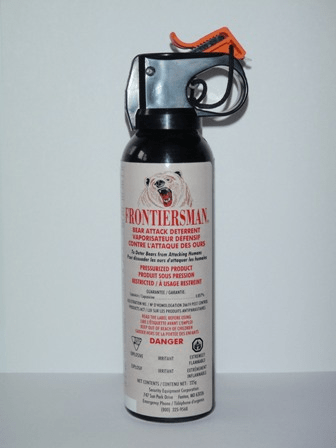
Things to Look for When Buying Bear Spray
When purchasing bear spray, check for:
- The expiry date of the spray
- Ensure it has a safety clip
- Does it say bear spray or bear repellent?
- The label must clearly show that it is intended for use on animals
- The size and strength of the product
- The package volume cannot exceed 500 ml
- Parks Canada recommends a 225 ml can (about 10 seconds worth) with 0.75%-1% capsaicin is recommended.
[Source: Government of Canada]
Carrying and Storing Bear Spray Legally
In Canada, bear spray is generally legal to purchase and carry when it is labelled and carried for animal deterrence. It is classified as a pest control product, not a personal self-defence weapon. Carrying bear spray for protection against other people can result in criminal charges, because it may be treated as a weapon depending on the circumstances and intent.
When carrying bear spray:
- Ensure it is clearly labelled as bear spray.
- Carry it in a visible holster if hiking or camping in bear country. Parks Canada recommends carrying it where it can be accessed quickly and checking for a safety clip and expiry date.
- Do not carry it into secure or screened locations where irritant sprays and similar items are prohibited (for example, courthouses and other controlled-entry buildings).
- Never state or imply that you are carrying it for use against another person.
If storing bear spray at home:
- Keep it out of reach of children and pets.
- Transport it in a way that reduces accidental discharge and avoids heat exposure.
- Store it in a cool, dry place.
- Avoid areas where it could be punctured or crushed.
Your intent matters legally. Even lawful items can become illegal if carried for an unlawful purpose.
When travelling with bear spray:
- Keep it with the safety clip secured.
- Transport it in a secure way that reduces accidental discharge and avoids heat exposure.
- Never leave bear spray in your vehicle for extended periods, especially in hot weather, as temperatures over approximately 48°C can cause the canister to burst or leak.
- Avoid storing it near open flames or heat sources.
Bear spray is prohibited in both carry-on and checked baggage on commercial flights in Canada. For cross-border travel, keep the canister clearly labelled for animal use and be prepared to explain it is for wildlife deterrence. Items may be seized if officers believe they are intended for use against people.
It is very important that bear spray remains in its original packaging with the manufacturer’s label clearly visible. The label demonstrates that the product is intended for animal deterrence. Removing labels, transferring contents to another container, or altering the packaging could create legal issues and may raise concerns about unlawful intent.
Have Questions About Bear Spray Laws or Criminal Charges?
Book a Free Consultation with a Leading Weapons Defence Lawyer.
Bear Spray Law FAQs
What will bear spray do to a human?
Bear spray will have similar effects on a human as other capsaicin-based sprays. Like pepper spray, it irritates the eyes and throat and causes an individual to have difficulty seeing and breathing. Effects are typically severe but temporary, although some people may experience serious symptoms depending on exposure and health conditions.
Is it legal to spray someone with bear spray?
Using bear spray against another person can be a criminal offence in Canada. It may be treated as a weapon depending on the circumstances and can lead to serious charges, including assault with a weapon.
What does bear spray feel like?
Bear spray would cause an intense burning sensation in the eyes, nose, throat, and on the skin, often with watering eyes and temporary loss of vision.
Is bear spray stronger than dog spray?
Yes, bear spray is stronger and more potent than dog spray. It contains a higher concentration of active ingredients (roughly 2.0% major capsaicinoids) designed for large, thick-furred animals, whereas dog spray (typically 1.0%–1.33% major capsaicinoids) is formulated for smaller, more sensitive animals. Bear spray also has a longer range and wider, fog-like dispersal pattern.
Can you carry bear spray on an airplane in Canada?
No, you cannot. Bear spray is prohibited in both carry-on and checked baggage on commercial flights in Canada. It is considered a dangerous good because it is a pressurized aerosol containing an irritant.
Is bear spray legal in every Canadian province?
Bear spray is generally legal to buy and possess across Canada when it is clearly labelled for animal deterrence. However, some provinces and municipalities have additional rules that restrict possession in certain public urban spaces or impose point-of-sale requirements. For example, Saskatchewan restricts possession in public urban spaces, and Manitoba requires photo ID and intended-use information at purchase.
Where can you legally carry bear spray in urban areas?
In many Canadian cities, carrying bear spray in urban areas can create legal risk if the facts suggest it is being carried for use against people. In some jurisdictions, it may be unlawful to possess bear spray in public urban spaces at all. For example, Saskatchewan restricts possession in public urban spaces such as parks, streets, and malls.
In rare situations, someone might have a legitimate reason to have bear spray in an urban area (for example, travelling directly to or from a wilderness location). However, each situation would be assessed based on the specific facts.
What are the legal consequences of carrying bear spray illegally?
Carrying bear spray illegally can lead to criminal charges depending on the circumstances, including carrying a concealed weapon (s.90(1)) or possession of a weapon for a purpose dangerous to the public peace (s.88). In jurisdictions with specific provincial rules, additional fines may apply.
When to Contact a Criminal Defence Lawyer
Bear spray is a powerful and effective tool that every survivalist should have when traveling into the woods. However, it can cause legal challenges for individuals possessing it for purposes other than protection against bears.
If you are facing charges related to the possession and use of bear spray, contact our experienced Toronto weapons offence lawyers to learn more about how we can help. Our experienced lawyers have over 23 years of experience and have defended over 1200 cases. Our lawyers have defended many weapons and firearm offences. A few notable case results are:
- R. v. Z.A. → Assault + Assault with a Weapon
- Outcome: all charges withdrawn, no peace bond, no admission of responsibility, no criminal record
- R. v. K.C. → Possession of a Weapon for a Dangerous Purpose
- Outcome: charge withdrawn, no finding of guilt, no criminal record
- R. v. M.S. → Assault with a Weapon + Possession of a Weapon for a Dangerous Purpose
- Outcome: all charges withdrawn, no criminal record, matter resolved through mental health diversion
- R. v. I.F. → Assault with a Weapon + Possession of a Weapon
- Outcome: all charges withdrawn, no criminal record
It is important to obtain immediate legal representation to ensure the best outcome. Immediate legal representation matters for various reasons. For example:
- It ensures your rights are protected during any investigations
- It avoids self-incrimination
- It ensures evidence is preserved early
- It allows for strategic decision-making early in the case
- It reduces potential legal consequences (for example, legal representation can help secure reduced charges, diversion programs, or withdrawals)
Charged with assault or weapons offences? Call us today at (416) 658-1818 or request a free case evaluation.
This article provides general legal information only and should not be construed as legal advice. Laws and their interpretation may change, and the application of law to specific circumstances requires professional legal assessment. If you have questions about a legal matter, please contact us for a free consultation.

Jonathan Pyzer
Jonathan Pyzer, B.A., L.L.B., is an experienced criminal defence lawyer and distinguished alumnus of McGill University and the University of Western Ontario. As the founder of Pyzer Criminal Lawyers, he brings over two decades of experience to his practice, having successfully represented hundreds of clients facing criminal charges throughout Toronto.
Request a Free
Case Evaluation





5.0
